Twilight Zone – Living by the word in a time of transition

images-11Here are some interesting insights that might be applicable to the moment you and I are living in, with the placings wherein God has set us.    Take your imagination and visit Samuel’s young life, having been left by his mother in the service of his God and learning what it is to be 1st given to God whilst being skilled in an environment less than suitable for a young child. Having been trained to hear God amongst a priesthood had forgotten or chosen to forget how to hear God. Young Samuel is experiencing quite a challenging environment as he seeks to faithfully serve God in the twilight zone.

He had to deal with:

  • The perplexing paradox of Eli
  • Incredible patience of God with the corrupt priesthood
  • Everything in Samuel’s Heart responded to Eli’s righteous exhortations, whereas nothing in him corresponded to Hophni or Phinehas’s lifestyle
  • The challenge of maintaining sensitivity to the voice of God
  • His deepening pain over what he was hearing from God and yet what he saw
  • The growing awareness that God would not allow the situation forever
  • The inner grief knowing that God would remove Eli as well as his sons
  • He did not try to do God’s job for him but held to the function God had given him to do, that is he surveyed, just  like on the Lord in the temple
  • There is no reference to Samuel’s involvement in the loss of the Ark of the Lord to the Philistines, nor its return to Israel.    The opening words showed he was ready for the moment; he recognised a signal from heaven to initiate a dramatic change in the nation “…if you are really serious…”  1 Sam. 7:3 (NLB)
  • Despite the spiritual darkness of his time, being trained as it was to a failing Eli, yet Samuel’s heart burned with passion and for God.

He kept faith in the covenant promises, the covenant purpose of God for the generation in which he lived and breathed

He was sustained by a continuing prophetic revelation of God which kept the little flame burning in his heart “the Lord appeared again at Shiloh, because the Lord revealed himself…by the word of the Lord. Thus the word of Samuel  came to all” 1 Sam. 3:21-4:1

Now the Lord not had a word for Samuel, if Samuel did not have a word Israel would not have been provide a word.

When the prophetic word comes:

  • It provokes change in attitude
  • It focuses the purpose of God so that you do not fall victim to forces that would love you to deviate from the Divine Purpose
  • It carries with it the wisdom essential to your establishing the gains already made, while propelling you forward to secure new gains, this is wonderfully pictured in Nehemiah when he is urging the people have sword and trowel in hand. A picture that showed to protect themselves what had been accomplished while working out what they were building.
  • It comes with passion and conviction as it is known as God speaking

In our day let us cultivate, create and be the sustainers of the prophetic passion, let us be those that work with what God has spoken, let us be those that take up the ultimate purpose and will of the father and make this ours. Let us avoid Christianity deteriorating into a competitive scramble by small-minded people trying to get more and more people to rally to a cause as opposed to working in harmony to the advance of the kingdom, disciplining the people, pursuing being united with God and keeping peace in the community of God, the church in the bonds of peace.


Passionate Prophets

images-11As we read through the scriptures especially the Old Testament we cannot but see that there were men and women such as Samuel and others like him who were before him and his successors were at the forefront of the purpose of God for their moment, they brought to a nation the flaming message of God’s word. They spoke to kings, rulers, governors and decision-makers who in turn attempt to put pressure these men and women to change their tone or to change their message, in essence to change their words, their prophesying.   But these men and women had settled something they were first and foremost servants of the most high, and despite all the pressures they remained so true to their first cause.    Individuals who are there to turn their gathered nations or people groups hearts and intentions towards God, they spoke and brought to all that they could hear God.

We are surrounded today with political electioneering whether it be on a local level, on a national level or even an international level. Electioneering  shows politicians of all shapes and sizes seeking to discover through opinion polls what the people want them to say on single issues. Unfortunately when this is discovered we find opinions changing,  adjustments of emphasis and repositioning all to gain position in accordance to what they discovered, this shows little of a convictional lifestyle. It will not be so with prophets, or the purpose, for they know the heart of God, the will of the Father, Son and Spirit. They are not politicians but prophets.

They themselves are the vehicle, the message they carry moulds and informs their lives, their whole action of life is painted by the message they carry, it is the school of the spirit  in their lives  shaping and forming and moulding them to be prophets.

A prophet has to become secure in their inner self so they find themselves never measuring themselves by people’s response to their word. The fulfilling release they have is knowing that they had been the voice of God in their time. The response to the word is an issue between the people and their God, the prophet is the deliverer, what they know is the word of God, which is living to them.

O God raise in our midst passionate prophets that bring to each of us your living, uncomplicated but  life-giving word.

Earths Cry, Heavens Desire.

images-11Have we not been encouraged and taught to raise a shout, or put it moe acceptable to PRAY “… as it is in heaven so shall it be on earth…”, is this not a disciples cry of heaven come to earth? along with heaven’s desire to come to creation, both being kaleidoscope together in words of power, words of purpose and the Will of the Father, words that align life with what God is saying.

I would strongly say that when the cry of heaven meets my cry, when we have the ‘…Spirit and the bride say come…’ one voice of heaven and earth, things are then about to change, heavens will and humanity submitted life.  There are so many colourful stories painted for us throughout the scriptures of human need being supplied by the hand of God.   More than that, the crying, of need and desire on earth often become the vessel of delivering Gods desire and requirement for the moment.

The wonderful story of Hannah, the mother of Samuel, she was willing in her desperate cry to be mistaken as a drunk, but she gave voice to her desire for a son on earth, there was another desire acted out in the courtroom of heaven, for a prophet.  Two worlds merged, two minds have the same answer, a son was born and a prophet arrived.

Hannah had a voice that would change the situation, as a result of the anguish of Hannah interceding for a child great change would come. I wonder how many of us would put these two things together a woman who is desperate for a child and a nation who desperately needed a prophet.   The heart of Hannah is so God centred she sees the will of the Father being greater than the desperation that you see it in her response. She did not become one that received the child and duly forgot God, but said from the beginning, give me my desperate desire and I will make your will O God the highest in my life. So she said “… if I receive this child, I will give him to the Lord…”. It was the heart attitude, my need, I’m pleading for my need, I’m crying with my need, but when my need is met I will give it back to God for God’s highest interest. I will not run away with my child but my child will be yours. In this my fullest satisfaction will be that all I have will be in the service of the will of the Father.

 What change would we bring, what powerful moment would break if we saw and learned that hearts can become the womb of the prayer of God 

Samuel grew in his early days  in the ways of a prophetic hope I’ve outlined it says “the lamp of God and not yet gone out…”. Of course this was a reference to the little boys’ duties of lighting the lights in the temple and holding  the lights until the small hours of the morning yet as Samuel Grew a deeper dimension of meaning in this context.   The lamp not gone out is a simple picture of God’s onward going commitment to the promises made, of God’s covenant that no testimony would be allowed to disappear before God acted to secure God’s purpose

Let me say now,  a prophetic promise people realise that God will never allow the circumstances and the spiritual state around to deteriorate to the point where the faith or testimony and commitment to the purposes of his will to be lost.   God has heard the prayers and cry’s of fathers and mothers that have gone before us, the sacrifices of generations God will uphold.

Realize now the covenant that God has been laid down, the covenant God made with Abraham and all those who stand in the lien of faith are all covenants of continuity.   This continuity is eternal, it will move through generation upon generation and age if necessary to accomplish itself there is a continuity in all that God is doing.

To every generation is given the time, the life and empowerment to serve God in freshness of its own word and vision,  a vision that has the hallmark of authenticity in its continuation of what has gone before.  Our authenticity is not that we are out there on the edge and different for the sake of difference but that there is a continuity of purpose even in the midst of dawning  a dynamic and ever arriving truth. We are to build upon and not be different to.

Anything that prides itself in building another foundation other than the foundation already laid is a falsehood, we talk about this foundation knowing there is only one foundation, only Christ, we see ourselves going all the way back to and aligning our the faith that goes back to Abraham.

We are to be a people who have an anchor who is Christ and not  just those with a prophetic flavour, but really to play with words what we are to have its prophetic fervour not flavour. To be in the line of Abraham means I need Abrahams fervour, his faith, his zeal, his vision of a city, his progress and his commitment.  The ability to passionately identify with God’s purpose should really be the catalyst this should sum up our generation, to bring out the prophetic fervour of God for the purpose of God.


United we stand…

UnknownI  have an appeal, I have a cry of the heart to make known.   It commenced as I was skipping along Facebook and Twitter submissions recently.   Watching the one line soundbites flooding in and being deeply aware that in no man or woman’s heart is the desire to separate or divide, but watching as the submissions pass by, some unknowingly even innocently will bring this about, asking people to stand on right or wrong sides, best or better, are you this persuasion or the other, do you subscribe or don’t you, this experience is the now way, it all sounds a little gnostic, I am saddened.   My cry is let us be united, I am so aware that God has done all in order that we are united with God, should we not do all to maintain this, for this is my cry.

We live in an age where other word carries more weight in our soul than the WORD of the Father, Son and Spirit, or at least that is how it seems.  The immense word that comes out of the divine circle, the dance that unceasingly goes on that we have been invited to participate with, and is not our passion our desire is for us to fill up this world with the life and therefore the Word of God. I read a submission recently, which seemed so good on the surface but I must admit it left me with a question, are we splitting hairs, through this it appears to be acceptable to separate once again on experiences. As one who has been baptized into belonging, like many of us through baptism, we are a people who are desirous to see the one body of Christ in our world, to see Christ filling all in all, allowing various viewpoints without undermining our heartfelt desire to be united as God is.  John 17 surely must become our priority not our theology, or experience, a question should it not all constructively direct us to the will of God?

John 17:21-23        I pray that they will all be one, just as you and I are one—as you are in me, Father, and I am in you. And may they be in us so that the world will believe you sent me. 

22 “I have given them the glory you gave me, so they may be one as we are one. 

23 I am in them and you are in me. May they experience such perfect unity that the world will know that you sent me and that you love them as much as you love me.

Now don’t get me wrong I strongly hold to diversity in every aspect of our faith and life, in our thinking and practice without being given over to every one doing what is right in their own eyes.     How can any one view, any one theology, any one experience deliver or fully describe our vast and wonderful God.      We live in a world where we recognize  that every culture, every colour, tribe and tongue is necessary to express God. There is no one person, no one age, no one culture that can faithfully express God in fullness, we are in need of every difference to make up the full testimony of the Father, Son and Spirit.    For is God not always presented to us in more than the one, God is covenantal.

Now back to my first thought, this submission that kicked this cry to the forefront of my mind was a quote that we do not need an encounter with the Bible but with the love of God.    Whereas I can agree and support the thought to a degree, it is the life encounter that transforms, appealing that we stay in the life of God, being sons of God ‘led by the Spirit, however here is my heartfelt plea, are not the Scriptures, the Word of God, the Bible the love of God, the Father made manifest?       Is not the word we can carry on our arms, hands, hearts and tongues, the Scriptures, the Bible the manifestation of the love of God, otherwise the love of God becomes an emotion, an encounter, an experience, whereas I experience the love of God and find my emotions stirred by the love of God through the Bible as I encounter their words, Christ is made manifest as I encounter him as the Word.    My appeal is simply let us not downgrade the Bible, the Scriptures but only love them, as yet another expression of the love of God, where we can encounter the Fathers love.  God’s words, Father Son and Spirit show their love through the Scriptures and in the Scriptures.

I am one that believes that the love of God through history has given us two Testaments the New Testament and Old Testament I also see God in the new covenant is writing a Third Testament.   You and I are to be a Testament written by the spirit and read by all men, letters that all can read and encounter Father, Son and Spirit.

Let us see the wide expression of vast different ways of the love of God, rather than set up what is right and wrong, person against person through our experience.   I know that is not our desire but unfortunately we do add to the practice the experience of who, what is superior or lesser on these matters.   God is love and his Word, the Scriptures, the Bible as we read it, is one place where we can, and do, encounter the Fathers love as in and through so many other vehicles 

 The love of God is delivered to us through many facets creation, scriptures, even modern-day films, anything really,  we can encounter the love of God in so much and we do!


Jesus impact

Interesting? I wonder what you will make of this or will you get lost on his…?

Bono by Michka Assayas is a fascinating book, especially for U2 fans.
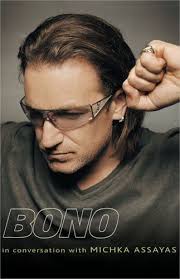
From the Amazon page:

Bono’s career is unlike any other in rock history. As the lead singer of U2, Bono has sold 130 million albums, won fourteen Grammys, and played numerous sold-out world tours, but he has also lobbied and worked with world leaders from Bill Clinton and George W. Bush to Nelson Mandela on debt relief, AIDS, and other critical global issues. He has collaborated with the same musicians for nearly three decades and has been married to his childhood sweetheart since 1982. His life, at all turns, resists the rock star clichés.

In a series of intimate conversations with his friend Michka Assayas, a music journalist who has been with the band since the very beginning, Bono reflects on his transformation from the extrovert singer of a small Irish post-punk band into one of the most famous individuals in the world; and from an international celebrity to an influential spokesperson for the Third World. He speaks candidly about his faith, family, commitment, influences, service, and passion. Bono: A Self-Portrait in Conversation is the closest we will come, for now, to a memoir from the iconic frontman of U2.”

What follows is an excerpt from the book where Bono talks about Jesus Christ in an interview with the author:

Bono: My understanding of the Scriptures has been made simple by the person of Christ. Christ teaches that God is love. What does that mean? What it means for me: a study of the life of Christ. Love here describes itself as a child born in straw poverty, the most vulnerable situation of all, without honor. I don’t let my religious world get too complicated. I just kind of go: Well, I think I know what God is. God is love, and as much as I respond [sighs] in allowing myself to be transformed by that love and acting in that love, that’s my religion. Where things get complicated for me, is when I try to live this love. Now that’s not so easy.

Michka: What about the God of the Old Testament? He wasn’t so “peace and love”?

Bono: There’s nothing hippie about my picture of Christ. The Gospels paint a picture of a very demanding, sometimes divisive love, but love it is. I accept the Old Testament as more of an action movie: blood, car chases, evacuations, a lot of special effects, seas dividing, mass murder, adultery. The children of God are running amok, wayward. Maybe that’s why they’re so relatable. But the way we would see it, those of us who are trying to figure out our Christian conundrum, is that the God of the Old Testament is like the journey from stern father to friend. When you’re a child, you need clear directions and some strict rules. But with Christ, we have access in a one-to-one relationship, for, as in the Old Testament, it was more one of worship and awe, a vertical relationship. The New Testament, on the other hand, we look across at a Jesus who looks familiar, horizontal. The combination is what makes the Cross.

Michka: Speaking of bloody action movies, we were talking about South and Central America last time. The Jesuit priests arrived there with the gospel in one hand and a rifle in the other.

Bono: I know, I know. Religion can be the enemy of God. It’s often what happens when God, like Elvis, has left the building. [laughs] A list of instructions where there was once conviction; dogma where once people just did it; a congregation led by a man where once they were led by the Holy Spirit. Discipline replacing discipleship. Why are you chuckling?

Michka: I think I am beginning to understand religion because I have started acting and thinking like a father. What do you make of that?

Bono: Yes, I think that’s normal. It’s a mind-blowing concept that the God who created the universe might be looking for company, a real relationship with people, but the thing that keeps me on my knees is the difference between Grace and Karma.

Michka: I haven’t heard you talk about that.

Bono: I really believe we’ve moved out of the realm of Karma into one of Grace.

Michka: Well, that doesn’t make it clearer for me.

Bono: You see, at the center of all religions is the idea of Karma. You know, what you put out comes back to you: an eye for an eye, a tooth for a tooth, or in physics; in physical laws every action is met by an equal or an opposite one. It’s clear to me that Karma is at the very heart of the universe. I’m absolutely sure of it. And yet, along comes this idea called Grace to upend all that “as you reap, so you will sow” stuff. Grace defies reason and logic. Love interrupts, if you like, the consequences of your actions, which in my case is very good news indeed, because I’ve done a lot of stupid stuff.

Michka: I’d be interested to hear that.

Bono: That’s between me and God. But I’d be in big trouble if Karma was going to finally be my judge. I’d be in deep s—. It doesn’t excuse my mistakes, but I’m holding out for Grace. I’m holding out that Jesus took my sins onto the Cross, because I know who I am, and I hope I don’t have to depend on my own religiosity.

Michka: The Son of God who takes away the sins of the world. I wish I could believe in that.

Bono: But I love the idea of the Sacrificial Lamb. I love the idea that God says: Look, you cretins, there are certain results to the way we are, to selfishness, and there’s a mortality as part of your very sinful nature, and, let’s face it, you’re not living a very good life, are you? There are consequences to actions. The point of the death of Christ is that Christ took on the sins of the world, so that what we put out did not come back to us, and that our sinful nature does not reap the obvious death. That’s the point. It should keep us humbled . It’s not our own good works that get us through the gates of heaven.

Michka: That’s a great idea, no denying it. Such great hope is wonderful, even though it’s close to lunacy, in my view. Christ has his rank among the world’s great thinkers. But Son of God, isn’t that farfetched?

Bono: No, it’s not farfetched to me. Look, the secular response to the Christ story always goes like this: he was a great prophet, obviously a very interesting guy, had a lot to say along the lines of other great prophets, be they Elijah, Muhammad, Buddha, or Confucius. But actually Christ doesn’t allow you that. He doesn’t let you off that hook. Christ says: No. I’m not saying I’m a teacher, don’t call me teacher. I’m not saying I’m a prophet. I’m saying: “I’m the Messiah.” I’m saying: “I am God incarnate.” And people say: No, no, please, just be a prophet. A prophet, we can take. You’re a bit eccentric. We’ve had John the Baptist eating locusts and wild honey, we can handle that. But don’t mention the “M” word! Because, you know, we’re gonna have to crucify you.

And he goes: No, no. I know you’re expecting me to come back with an army, and set you free from these creeps, but actually I am the Messiah. At this point, everyone starts staring at their shoes, and says: Oh, my God, he’s gonna keep saying this. So what you’re left with is: either Christ was who He said He was the Messiah or a complete nutcase. I mean, we’re talking nutcase on the level of Charles Manson. This man was like some of the people we’ve been talking about earlier. This man was strapping himself to a bomb, and had “King of the Jews” on his head, and, as they were putting him up on the Cross, was going: OK, martyrdom, here we go. Bring on the pain! I can take it. I’m not joking here. The idea that the entire course of civilization for over half of the globe could have its fate changed and turned upside-down by a nutcase, for me, that’s farfetched

If only we could be a bit more like Him, the world would be transformed. When I look at the Cross of Christ, what I see up there is all my s— and everybody else’s. So I ask myself a question a lot of people have asked: Who is this man? And was He who He said He was, or was He just a religious nut? And there it is, and that’s the question. And no one can talk you into it or out of it.