I would often tell people that I didn’t have a choice in the maker’s workshop between male and female forms; Father, Son, and Holy Spirit did not debate with you about your gender. Neither does anyone else. I was not offered a choice in my mother’s womb; I conclude that being male or female is a gift from God. Until we see that and live accordingly, rather than competitively or domineeringly, we will always have sexism.
I have to state from the outset that I am not a feminist at all, nor do I wish to participate in the age-old war between the sexes. I am deeply aware that if we do not find all we see within the nature of God, it will become a fad rather than an established principle. This is my reason for this outline as a starting point. I believe it’s time not to have ‘women in leadership’ as some state to show they are ‘for women’, but we have an anchored understanding in the nature of God for male and female. Unfortunately, within the religious world, we have instilled a practice that stems from a misunderstanding of God’s view of male and female. This has set up headship in an incorrect fashion, and more reflects culture and social structures than what Father, Son and Holy Spirit – God – ever intended.
It is a rather long read for which I apologise; however, I believe it is helpful. I initially wanted to cover some fundamentals on the matter; forgive me for the many words.
Here is a statement to start. There is nothing domineering in God that we are meant to emulate; far from it—Father, Son, and Holy Spirit (God). God is revealed in self-emptying, preferring the other rather than establishing who is at the top. God’s movement, the Father, Son, and Holy Spirit functioning and flowing, does not support hierarchy at all, yet we have placed this front and centre within the religious and church world. Someone must be on top; this mentality often prevails within the church rather than embracing Jesus’ statement that He came not to be served, but to serve—ultimately shown in Jesus pouring Himself out for humanity. We should also emulate this. The pouring out of God brings about the restoration of humanity’s image and likeness, as well as the restoration of creation to God’s ultimate intention. A way of living that produces fear or domineering does not represent God.
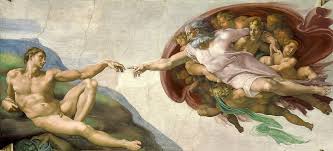
Where shall I begin with my thoughts? I recall an old song sung by Julie Andrews, playing the part of the nun Maria in the ‘Sound of Music’ film, that went “[MARIA sung] Let’s start at the very beginning, A very good place to start”. I suppose the best place is at the beginning, reaching back to Genesis 1, where the Father, Son and Holy Spirit, the Trinity in action, move as one to create, the Father, Son and Holy Spirit creating. First, create a time-space world and place mankind alongside the community of creation. This is a time before the whole of creation is defaced and the image is defaced. Hold this thought for now. We were created in the Community of Creation, not just humanity but all of creation.
Gen. 1;26-28
26 “Then God said, ‘Let us make mankind in our image, in our likeness, so that they may rule over the fish in the sea and the birds in the sky, over the livestock and all the wild animals, and over all the creatures that move along the ground.’ 27 So God created mankind in his own image, in the image of God he created them; male and female he created them. 28 God blessed them and said to them, ‘Be fruitful and increase in number; fill the earth and subdue it. Rule over the fish in the sea and the birds in the sky and over every living creature that moves on the ground.’”
The terms “image” (Hebrew: tselem) and “likeness” (demut) are fundamental to understanding human identity in Judeo-Christian thought.
Image (tselem): Often interpreted as a representation or reflection; it implies that humans are a visible reflection of God’s presence in creation.
Likeness (Demut): Suggests similarity rather than identity; humans are like God in certain ways, but not divine, I must add.
Verse 26 of Genesis 1 says that the Father, the Son and the Holy Spirit created “mankind” in God’s image and likeness.
The word “mankind” is the Hebrew word adamah. Unfortunately, we depart from the original form and aim of the narrative here. In adamah, it denotes humanity, in which both maleness and femaleness are present but not yet seen or understood; however, we will get there. The form “Adam” is used some 20 times as a proper name; it is used more than 500 times (Adamah) in reference to humanity.
The word has exciting aspects, as its root is adamah, the Hebrew word for “ground’ or “earth”. This establishes the foundation before we consider the gender view that humanity, male and female, have a powerful and unique relationship with creation, planet Earth, and the community of creation. This opens up a whole new view on creation and eschatology, perhaps a topic for another time.
While Gen. 1 introduces us to adamah – humanity, in the narrative extended in Gen. 2, when ‘woman’ (ish-shah) is formed from humanity (adamah), please note that God also calls the man ‘Adam’, a proper name. From this time forward, the text shows that the words for male (ish) and female (ish-shah) are used to distinguish Adam and Eve (Chavah). Eve is not named until after what is traditionally called ‘the Fall’. Prior to that, she was referred to as ish-shah. Chavah (Zoe), meaning the “to give life” or “living one,” became the mother of all life. Already, a challenge to consider “mother of all life” for some readers, I am sure.
Let us be very clear that when the adamah is created in the image and likeness of God, it refers to “them” (hem), meaning humans, “male and female”, not man–male. This is an age-old misrepresentation of the text. It’s not that males were created first, then females, as a created order giving headship to males; this would be a misuse of the text. For example, if a hierarchy of creation were being established, we would need to maintain integrity and apply it consistently across the whole created order.
Let me explain the hierarchy in creation we have:
Day 5: Sea Creatures and Birds
- God filled the waters with living creatures and the sky with birds, blessing them to multiply. “Let the waters teem with swarms of living creatures, and let birds fly above the earth in the open expanse of the heavens.” God created the great sea monsters and every living creature that moves, with which the waters swarmed after their kind, and every winged bird after its kind; and God saw that it was good.
Day 6: Land Animals and Humanity
- God created land animals and then humans, giving humanity dominion over the earth. Let the earth bring forth living creatures after their kind: cattle and creeping things and beasts of the earthafter their kind” And it was so. God made the beasts of the earth after their kind, and the cattle after their kind, and everything that creeps on the ground after its kind; and God saw that it was good.
Following this, we have humanity being created. If the narrative upholds a hierarchy, creeping things would have a superior position in the order. This would preserve the integrity of creation, would it not? I would say that the argument that man is superior to woman cannot be established in a logical order, nor can this passage be used to establish that.
The reason for creating Gen 2:18 “It is not good for the man to be alone; I will make him a helpersuitable for him” (see the article to follow, ‘Helper – is not the little woman indoors’).
At this stage, you should recall the Genesis text that states, “it is not good for mankind to be alone”, followed by the reordering of Adamah and the creation of male and female. The reason for this is readily apparent if we view the Father, Son, and Holy Spirit as God, in whom mankind is created in the image and likeness of God. Humanity could not be alone in expressing God, who is in continuous community.
Simply put, there will always be a need for more than one person to reflect God.
If we view God hierarchically, this aloneness is not apparent; however, from a Trinitarian perspective, God is never alone, always in a state of Divine community. Therefore, mankind could never be a single being but must be a community, not only of creation but a community of the same essence. One could say that God thought, “Adamah does not reflect the Godhead; there must be more than one to do so”. Alone, singularity is not within the Divine shape. Unfortunately, over the years, I have come across the suggestion that God brought animals to Adamah to see if any was suitable. This is ridiculous. Do you not think God would know that there is nothing suitable? It was not a trial to see if anything fits. God is God! If nothing else, the animals, etc., are not the same substance-essence as Adamah in creation; there could never have been intimate relationships across different substances-essence. Animals were formed from a word spoken, “Let there be”, whereas for humanity it was different. God took clay and “formed” it, moulded, shaped, then breathed the breath of God into the clay, a different substance-essence to all other created forms, a union of Earth and God in the breath, God’s intent that humanity and God would be a demonstration of Heaven (domain of God) and Earth (domain of created humanity) together. A union of both heaven and earth. One may say that it was an eschatological creation, displaying God’s aim of a mature humanity and bringing about the union of both the seen and unseen realms.
Established image and likeness to be seen in a community.
Rib
Another consideration: I was always instructed that the first principle of biblical interpretation is ‘let the scripture interpret the scripture’. That is, if an idea or premise is outlined, find where else it appears, where else the words are used in scripture, and what light is shed on the ideas or the use of words.
To keep this interpretative practice regarding the word “rib”, consider where else it is used. Unfortunately, the word has been utilised to strengthen the subordinate position of women under men. We suggest having just a ‘rib” in view. God took a small bone from the rib cage of man to create woman, and woman is quite often seen as lesser because of this. Then it is said that this indicates that a woman needs to be under the arm of a man, protected and, at worst, subservient to men. However, on reading the scripture, even Adam gives us an insight. After the reconfiguration of Adam as humanity, Adam came forth and declared that woman is more than a rib-bone in Gen 2:23. The man said, “This is now bone of my bones, And flesh of my flesh; She shall be called Woman, because she was taken out of humanity (Adamah).” That is, Adam said she is more than just bone but has my flesh (1320 בָּשָׂר [basar /baw·sawr/] translates as “flesh” 256 times, “body” twice, “fatfleshed + 1277” twice, “leanfleshed + 1851” twice, “kin” twice, “leanfleshed + 7534” once, “mankind + 376” once, “myself” once, “nakedness” once, and “skin” once. 1 flesh. 1a of the body. 1a1 of humans. 1a2 of animals. 1b the body itself. 1c male organ of generation (euphemism). 1d kindred, blood-relations. 1e flesh as frail or erring (man against God). 1f all living things. 1g animals. 1h mankind).
Now for a note from a good friend, a Hebrew student and scholar, John Mastrogiovanni, which helps to see something more clearly, considering the Hebrew has certainly assisted here:
Remember the phrase, as usually translated, “And Adam said: ‘This is now bone of my bones and flesh of my flesh…? There’s a Hebrew word, in some cases completely messing, or at best loosely translated, הפעם (ha’pa’am), meaning to keep time or strike a rhythm, as in the rhythm of the hoofs of a running horse [Ancient Hebrew Lexicon].

This is the root word for “bell” as in the striking of an instrument, the steps of the feet, etc. In that moment, it’s revealed that both the masculine and feminine qualities are to beat (like a heart) in rhythm with each other. The rhythm is described literally as “bone of my bones, flesh of my flesh”. It’s not just the issue of bones and flesh, but the cadence of the words.
The collective Creature, Adam, prior to the rib incident, had a greater sense of egoism than consciousness of the feminine.
For example, throughout Genesis 1, after every point of creation, it concludes with “And God saw it was good.”
In Hebrew, the word טוב, good, doesn’t just mean good, but “functioning according to design.” However! When God finishes “The Adam”, which is God’s Image and Likeness, the balance and union of male and female qualities, the text says, as He looks at all lטוב, creation, it was very good, more literally it was “from the fiery embers (the מאד ego) is functioning according to design.”
When the masculine and feminine qualities are recognisably in balance, the ego functions properly, which is simply the Desire to Receive and Give.
However, something happens in Genesis 2.
17 “…but of the tree of the knowledge of good and evil you shall not eat, for in the day that you eat of it you shall surely die.” 18 And the Lord God said, “It is not good that man should be alone…” NKJV
Note the phrase “not good” (not functioning according to…“ לבדו design), existing, The Adam, to him alone (a state of separation and perish)”
The question is, what happened if in the first chapter all was very good, and now ‘The Adam’ is becoming “not good”? Quick answer: the ego was no longer in balance; the masculine and feminine qualities were out of balance.
The ego progressed to the point of feeling alone and separated, which is a state of perishing (meaning the loss of one’s sense of identity).
You could say, The Adam – adamah wasn’t just self-aware, but now “selfishly aware”.
In Revelation 9:11, it says: And they had as king over them the angel of the bottomless pit, whose name in Hebrew is Abaddon, but in Greek he has the name Apollyon. NKJV
The name of the king over the bottomless pit in Hebrew (same as in Genesis) is Aloneness (separation and perish). The Greek word means the same, although it is often translated as destruction or destroyer as well.
According to Ezekiel 28 and 31 the Tree of the Knowledge of Good and Evil became egoistic through its awareness and became selfish; hence, out of balance. The Adam, who was the keeper of the Garden, cultivated the Tree. Meaning, The Adam cultivated its egoistic awareness to the point of an imbalance. The feminine quality was no longer recognisable. Thus, God put The Adam in a deep sleep, removed The Adam’s rib and showed it the now dominant masculine quality.
In Hebrew, the word for “image” (as in “image and likeness”) is צלם, pronounced tselem. By letter definition in the Hebrew language, it means the image (or shadow) that reaches upward and flows like water.
The word for rib in Hebrew is צלע, pronounced tsela. The only difference is a change in the last letter from the ם (mem) to the ע (ayin). The letter ע (ayin) means eye or that which can be seen.
By letter definition, it means the image (or shadow) that reaches upward and can be seen. God was presenting to the male (masculine) his feminine quality, thereby creating balance and restoring to being the Divine Image.
Of course, we know how this story goes. The egoistic force of knowing good and evil (the Serpent) convinces the feminine to partake; however, something shifts.
When confronted with what happened, the feminine tells the truth, while the masculine accuses both the feminine quality and the Creator of the predicament (Genesis 3:12).
The masculine affirms through its egoistic accusation, separation.
On the other hand, the feminine did not accuse but told the truth as to why she ate.
Thus, therein is the shift to the next phase of development. It’s after this The Adam’s state of separation through the masculine’s accusation, the feminine receives the name (Genesis 3:20),
(Chavah) in Greek, Zoe (not Eve). The word Eve isn’t used for the woman till ( חוה Genesis 4:1 (in the Greek Septuagint, why?).
Why? Because חוה (Chavah), as in all Hebrew words, is multifaceted. חוה (Chavah) means Life-giver, and message-bringer.
Hence, the word Eve, is the root word for evangelism.
But in Genesis 3:20 the word Zoe (not Eve) is used because she will bring forth (or birth) Eternal Life, the Christ. It’s in her birthing the Christ into the lower egoistic world, that balance is restored and our identity as the Divine Image and Likeness is seen.
An old Beatles song, I Need Somebody (Help), not just anybody (Help). You know I need someone
We come to another word that requires examination, namely “Helper” or “help meet”, which is often used to convey the idea that she was man’s helper and inferior. However, upon examining the word ‘helper,’ we are in for a surprise.
The word “helper” (the Hebrew is “ezer,” meaning help or helper) is the same word used of God; more often than not, it refers to the Father, the Son, and the Holy Spirit – God. It appears 66 times in Scripture. This “ezer” (pronounced “ay-zer”) speaks of God’s strength, power, protection, help, and role as a rescuer. Therefore, to consider the word as a lesser help, as is often placed upon women, is not to consider its word usage and context within the Scripture. God is our helper, our help meet!
A bit of a shock, not the ‘little women indoors’, far from it. Forgive me for saying it, but I’m just trying to show that it’s misused. Here, God adds to ‘ishah’ a very nature and character of God. You can see me in her, said God. Too often, the idea of a helper is someone less than the other, such as an unskilled worker who helps a skilled one, or someone less in status or education than the one being helped. Often, a woman’s role has been seen as subservient to that of a man. Not so in God’s created order. A woman is a helper, but so is God. (Exodus 18:4 – Eliezer; 1 Samuel 7:12 – a stone of help; John 14:16, 17 Holy Spirit; Psalm 46:1)
It continues, the term “suitable” in the text derives from the Hebrew word “neged” (neh’-ghed), meaning “in front of, in sight of, opposite to” (Strong’s 5048). It also suggests that this “suitable” person is conspicuous, vigorous, a leader, and effective, and that they stand out boldly, explain, praise, expound, expose, plainly profess, report, tell, and utter.
This uneventful word, “suitable”, doesn’t possess much class in itself, but when you look at the meaning God gave the woman, that changes everything! She was equal to him, his opposite, able to help, a companion, one who would speak up and advise, and one who would face life’s joys and sorrows together, completing each other. Each had a mind to think, a heart to feel, and a spirit that would live forever. Not a silent companion, a homemaker, but a gift to man with purpose. If we do not grapple with this on male and female, we will always have dominant individuals within our structures, and generally, historically, it’s the male figure, which is not God’s ultimate goal. Unfortunately, we are all subject to the translator’s culture, along with our own traditions, rather than what is found in the text.
It gets better. Look at the word helper. I will do so in another article for you.
How magnificent and powerful are males and females. Living, functioning and working together, men and women reflect and express the nature of God. To be honest, male and female, as individuals, are separate and alone, and they are incomplete in revealing God’s nature – Father, Son and Holy Spirit. It might be a true definition of humanity only when male and female are together, being fully human. This, I would say, is what Paul the apostle calls the mystery of marriage, a covenant expressing union; however, it’s not only marriage, but also society: every sphere is better off when men and women function together in harmony.
Together, men and women reveal the nature of God and embody what it means to be human.
Both males and females have been entrusted with God’s goal and ultimate intention, namely that they reveal God’s nature and, together, fulfil His purpose. Not a structure of one above and the other below, but corporate in every way. Manifesting, mirroring the life in the Father, Son and Holy Spirit rather than the fallen condition of dominance and hierarchy.
We will not be able to bring about the completion of all things alone, nor can we steward the earth as custodians on God’s behalf. That Creation may be completed through man and woman in right relationship – Sons of God, creation groaning and mourning for us to stand
The purpose of God is to represent the created order and to manage the earth in accordance with God’s will, a task that can be accomplished only together, as male and female.
It’s worth looking again at how humanity is to rule and work within the creation community, not to dominate or rape its wealth for sale, but to fulfil God’s desire.
Humanity, male and female, is entrusted to rule, serve, and advance the created world, not to dominate or be over one another. In fact, we are not to dominate in any way. Rereading Genesis 2, with an understanding of the words used, will further clarify how we are to fulfil our roles together. Isa and Ishaha, man and woman, are to steward the garden entrusted to them and to raise the first family (vv. 8-25).
Adam and Eve are not to be on top of the call, but going forth and multiplying, releasing children into maturity, brings about God’s ways, revealing God’s nature as Father, Son, and Holy Spirit, enabling humanity to co-work with one another and co-labour with God, and to participate with God.
I will follow up on this with another blog soon on ‘Helper’ more fully, watch out for it.