9 things that will come to pass.

I came across this recently thought-provoking list.   It’s a list of 9 things that will pass away in our lifetime, what will your world be like If these pass?   Start thinking and realizing the effect on our life style

Whether these changes are good or bad depends in part on how we adapt to them. But, ready or not, here they come…

1. The Post Office. Get ready to imagine a world without the post office. They are so deeply in financial trouble that there is probably no way to sustain it long-term. Email, Fed Ex, and UPS have just about wiped out the minimum revenue needed to keep the post office alive. Most of your mail every day is junk mail and bills.

2. The Cheque. Britain is already laying the groundwork to do away with cheque by 2018. It costs the financial system billions of dollars a year to process cheques. Plastic cards and online transactions will lead to the eventual demise of the cheque. This plays right into the death of the post office. If you never paid your bills by mail and never received them by mail, the post office would absolutely go out of business.

3. The Newspaper. The younger generation simply doesn’t read the newspaper. They certainly don’t subscribe to a daily delivered print edition. That may go the way of the milkman and the laundry man. As for reading the paper online, get ready to pay for it. The rise in mobile Internet devices and e-readers has caused all the newspaper and magazine publishers to form an alliance. They have met with Apple, Amazon, and the major cell phone companies to develop a model for paid subscription services.

4. The Book. You say you will never give up the physical book that you hold in your hand and turn the literal pages. I said the same thing about downloading music from iTunes. I wanted my hard copy CD. But I quickly changed my mind when I discovered that I could get albums for half the price without ever leaving home to get the latest music. The same thing will happen with books. You can browse a bookstore online and even read a preview chapter before you buy. And the price is less than half that of a real book. And think of the convenience! Once you start flicking your fingers on the screen instead of the book, you find that you are lost in the story, can’t wait to see what happens next, and you forget that you’re holding a gadget instead of a book.

5. The Land Line Telephone. Unless you have a large family and make a lot of local calls, you don’t need it anymore. Most people keep it simply because they’ve always had it. But you are paying double charges for that extra service. All the cell phone companies will let you call customers using the same cell provider for no charge against your minutes

6. Music. This is one of the saddest parts of the change story. The music industry is dying a slow death. Not just because of illegal downloading. It’s the lack of innovative new music being given a chance to get to the people who would like to hear it. Greed and corruption is the problem. The record labels and the radio conglomerates are simply self-destructing. Over 40% of the music purchased today is “catalogue items,” meaning traditional music that the public is familiar with. Older established artists. This is also true on the live concert circuit. To explore this fascinating and disturbing topic further, check out the book, “Appetite for Self-Destruction” by Steve Knopper, and the video documentary, “Before the Music Dies.”

7. Television. Revenues to the networks are down dramatically. Not just because of the economy. People are watching TV and movies streamed from their computers. And they’re playing games and doing lots of other things that take up the time that used to be spent watching TV. Prime time shows have degenerated down to lower than the lowest common denominator. Cable rates are skyrocketing and commercials run about every 4 minutes and 30 seconds. I say good riddance to most of it. It’s time for the cable companies to be put out of our misery. Let the people choose what they want to watch online and through Netflix.

8. The “Things” That You Own. Many of the very possessions that we used to own are still in our lives, but we may not actually own them in the future. They may simply reside in “the cloud.” Today your computer has a hard drive and you store your pictures, music, movies, and documents. Your software is on a CD or DVD, and you can always re-install it if need be. But all of that is changing. Apple, Microsoft, and Google are all finishing up their latest “cloud services.” That means that when you turn on a computer, the Internet will be built into the operating system. So, Windows, Google, and the Mac OS will be tied straight into the Internet. If you click an icon, it will open something in the Internet cloud. If you save something, it will be saved to the cloud. And you may pay a monthly subscription fee to the cloud provider. In this virtual world, you can access your music or your books, or your whatever from any laptop or handheld device. That’s the good news. But, will you actually own any of this “stuff” or will it all be able to disappear at any moment in a big “Poof?” Will most of the things in our lives be disposable and whimsical? It makes you want to run to the closet and pull out that photo album, grab a book from the shelf, or open up a CD case and pull out the insert.

9. Privacy. If there ever was a concept that we can look back on nostalgically, it would be privacy. That’s gone. It’s been gone for a long time anyway. There are cameras on the street, in most of the buildings, and even built into your computer and cell phone. But you can be sure that 24/7, “They” know who you are and where you are, right down to the GPS coordinates, and the Google Street View. If you buy something, your habit is put into a zillion profiles, and your ads will change to reflect those habits. “They” will try to get you to buy something else. Again and again.
Money, money and all that

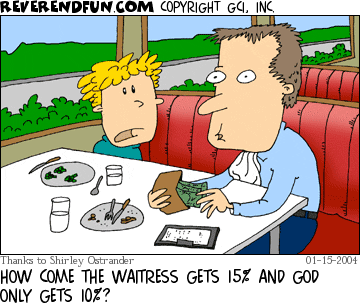
Interesting thought from a book written by Craig L. Blomberg on “A Christian View Of Possessions”, an academic, his expertise and fields of research are Economics and Hebrew he writes “More than a billion people out of the earth’s seven billion inhabitants live in desperate poverty.  Natural disasters, war, corrupt governments, lack of education, human greed, disease, unfair trade laws, false religions all play their part in creating this situation.   Conservatively, at least 200 million (1/5th) of these poor are Bible-believinng, born-again Christians”.

In taking on board his comments we today as Bible-beliveing Christians worldwide, heralding the coming of the Kingdom of God cannot see it as someone else’s responsibility be the answer, we must be part of the answer.   The Kingdom of God is not only miracles and healing, if this is our only focus we will be distracted from the fuller gospel of the Kingdom.

He goes on to say that just in America, let alone the remaining world “…over the last 30 years Christians have changed their spending patterns…the amount of money spent on non-essentials as sports and recreation, lawn care, video and computer games, home entertainment centres, pets and dieting has skyrocketed. At the same time Christians per capital giving to causes of all kinds has steadily declined in the last 40 years from just under 4% of their total annual income to barely above 2%”.

He then delivers a punch with “…trend watchers have made two staggering calculations…firstly if every USA Christian simply tithed, the additional amount of money that would be raised above and beyond current giving levels would be enough to eradicate world poverty in our lifetime.  Secondly the average age of major donors is now, for the first time ever, well over sixty-five.   Current Christian work is being funded largely by retired people.   Unless we change, in less than a generation the majority of ministries and good works will close their doors in reaching the poor.”

I write this with these thoughts, if we all saw the biblical, not tradition instruction on money, seeing the tithe as an answer not something to fight against, along with the biblical necessity of financial stewardship as part of a working answer perhaps a difference would dawn in our world.    If the whole church tithed worldwide, not just Europe or the West, but the whole church, we could eradicate world debt in less than 15/20 years.   What a powerful argument, of course we would need to agree to stop investing further in internal building programs, adding to men and women’s egos, running  bigger and better and getting more cut of the Christian market share.   We would need to distance our selves from the annual $7 billion Christian market but taking up the Apostolic & Biblical direction “never to forget the poor”.     Truly this would be the Isaiah 2:2, 3 “In the last days the mountain of the Lord’s temple will be established as the highest of the mountains; it will be exalted above the hills, and all nations will stream to it. Many peoples will come and say, “Come, let us go up to the mountain of the Lord, to the temple of the God of Jacob.  He will teach us his ways, so that we may walk in his paths.”   It will not be governments of politic or polices but the people of God that will have dealt with world poverty, this is truly the Kingdom of God coming to earth!

Before you get the wrong idea I am certainly not against buildings or exiting programs as we reach our world far from it.    However we are told that only 4/6% of the church worldwide actually tithes, and we all would admit the church downs amazing on that alone but the thought is not to affect existing budgets or support at all but just to apply the other 96/94% increase of giving and see what we can change?

 Join with us in changing our spending habits, join with us in making a difference with others while being the instructive Mountain of God, join and make  a difference rather than allowing the church to be something other than the Father has in his ultimate intention.    Being a different kind of people who creation awaits for sons of God led by the Spirit.
For the West he says lest get delivered from “…the already affluent becoming richer…” or let us not think about the well-to-do Christians “…trade places with the poor…” for both extreme prove un-biblical and prevent any action.
Let us join and become the Kingdom heralding, called out people of God bring a world answer!    Its time to truly study the scriptures and discover the real answers that has been outline there in about financial stewardship.

A Room with a View II

A couple of blogs ago I hope you recall the first part of this article which outlined the importance of how we see things, our view, our whole being is determined by what view we allow to fill our minds of God.   Our view of God is where our liberty is found, it is where our expression comes from, it is where our life flows.    These simple thoughts are meant to get us considering our view of God.    Your liberty is held here, a revelatory encounter will change you and bring you through in life, making such a difference to us all.   Let us continue in our journey of liberty and freedom.

GLORIOUS

God’s glory is His multifaceted perfection put on display.  It is, among other things, His incomprehensible love, His infinite hatred of evil expressed in His wrath, His tender mercy, His amazing grace, His love of justice, His boundless wisdom, and His iridescent holiness. God glorifies Himself by loving and exercising each of these traits. He created the universe and redeemed us to display His glory. It is His ultimate passion.

Remember, before God created the universe He had existed eternally in a perfect trinity of love. The love of His glory as it appeared in the other members of the Godhead was His consuming occupation. The Father rejoiced in His glory as He saw it in His Son, the “exact representation of his being” (Heb. 1:3). The Son exulted in His glory as it appeared in the Father. This love overflowed in a limitless ocean of eternal, unbroken joy. God in three persons loved His glory as He beheld it in each member of the trinity. Referring to this, Jesus prayed, “Father, glorify me in your presence with the glory I had with you before the world began” (Jn. 17:5).

When He created the universe, it was for the display of the glory each member of the trinity had already experienced before creation. That is why the Bible continually tells us that God does everything for His glory, and it never apologizes for these statements.

Now lets go back to John 17 again as outlined Jesus talks about the glory that he was given “…before the world began…” the amazing things is in this account of his word, the words he used just prior to his arrest Jesus included this statement in the middle of the Jesus prayer, his real prayer, his cry for oneness in his body 20-26                                                                                     “My prayer is not for them alone. I pray also for those who will believe in me through their message, that all of them may be one, Father, just as you are in me and I am in you May they also be in us so that the world may believe that you have sent me. 22 I have given them the glory that you gave me, that they may be one as we are one 23 I in them and you in me—so that they may be brought to complete unity. Then the world will know that you sent meand have loved them even as you have loved me.                                                                                                          24 “Father, I want those you have given meto be with me where I am, and to see my glory, the glory you have given me because you loved me before the creation of the world.                                                          25 “Righteous Father, though the world does not know you, I know you, and they know that you have sent me. 26 I have made you known to them, and will continue to make you known in order that the love you have for me may be in them and that I myself may be in them.”

The church has been given Jesus’ glory so we can stop chasing after it,  and just be the gift of glory to our world.

Lets now move on to another scripture that is captured in the account of Moses’s conversation with the Father, its the conversation around the presence of God going with Moses.   It has to be said that there is a fundamental difference for you and I to Moses’ experience, our experience today is that the Fathers presence has come to us as believer in Christ, we, as those who now believe never walk outside or away from his presence, it is the essence of the gift of abundant life “…he will never leave or forsake us…”

Now to Exodus 33:18-19.  Then Moses said, “Now show me your glory.” 19 And the Lord said, “I will cause all my goodness to passin front of you, and I will proclaim my name, the Lord, in your presence. I will have mercy on whom I will have mercy, and I will have compassion on whom I will have compassion.

See it, Moses asked to see his glory, what passed by, what did he see?   The glory was manifested in two things his “goodness” and his “name” and we are now to extend his glory by showing his goodness to all mankind, and to the people of God he has given his name, the church being the glorious body of Christ and the carrier of his glory in lives being fully lived out.

FATHER

As a very young Christian, I stumbled onto a verse in Psalm 27 that piqued my curiosity as much as it unnerved me. It spoke of something I could not then imagine: “For my father and my mother have forsaken me, but the LORD will take me up” (Ps. 27:10, NASB).

I am my father’s first child—born in 1956 a reason for him to come home from the dark coal pits of South Wales, he would come home from the coal mines,  wash the dirt of the underground away and say I am here, I will always be here for you.    My dad leaving me, forsaking me how could that ever happen to me?

As I moved out into life I slowly realized that every father fails or “forsakes.” He fails as every human fails—and, worst insult of all, he dies.    My Father died over 15 years ago and when my mother passed away a few years ago a strange thing happen I felt like an orphan, until God overwhelmed me, moved on me and showed me I was not an orphan at all but a son of God.   At that point I could have allowed an orphan spirit to take over, or become like Melchizedek with no mother or father,  I choose to be the latter and the orphan spirit left me.    We realize as we journey in life that our fathers cannot fully father us, then we discover what God has been waiting to reveal: He will take us up. It is in those moments when life hands us a tiny shred of “orphan-ness”—of being on our own—that God the Father is especially present, longing for us to take our hands out of any human hands and grasp His.

He is our Father and longs to have a family; God will bring us to Sonship though his fathering.  We see it even in John 3:16 “For God so loved he gave” his love come forward and manifested in a Son his love gave as it has no boundaries, or control and withholds nothing.    So Jesus is the love of the Father manifested, this love removed the orphan nature of humanity that came through the loss of Adam in the garden, by bring us into Sonship by the love of God giving us the gift of his Son as his love manifested.   We are all given the opportunity to mature in Sonship.

Adam lost his sonship and became an orphan that has affected the whole of creation; Jesus came and died to recover the Fathers ultimate intention.   That God is a Father who longs for a family this is what he had in mind prior to creation.

Movement Dynamics by Tim Keller

The Global Cities Initiative Conference took place in New York City on September 9 – 11, 2009. Over 80 cities were represented by ministry leaders and church planters. Tim Keller gave three plenary addresses at GCI. Go here for info – “Gospel Renewal” – “City Focus – “Movements & Ecosystems”

His discussion of movement dynamics, with the following characteristics: [summary by Jay Lorenzen: Campus Crusade for Christ]

  1. Unified vision and beliefs,
  2. Cooperation and catholicity of spirit,
  3. Sacrificial commitment,
  4. Spontaneity and creativity.

Below is a summary of his points as Tim compared a movement with an institution. Let me suggest that you discuss these “dynamics” with your missional teams and help move your ministry to a movement and keep it from becoming an institution.

DYNAMIC 1: UNITY (THE FOCUS)

Oneness from common vision and beliefs: A movement is driven by a clear vision for a particular future reality, based on common beliefs.

Marks of a movement

1. Organized around a common vision for the future.

2. All leaders and key players share same goals.

3. Forward movement through arriving at consensus or near consensus on next stage in reaching the vision.

Marks of an institution

1. Organized around by-laws and ground rules.

2. Each leader/department presses for own differing agenda.

3. Forward movement through negotiated compromises to form agreed upon ‘strategy.’

DYNAMIC 2: CATHOLICITY (THE OPENNESS)

Emphasis on cooperation across lines: A movement is peopled by workers who put the vision ahead of other differences and learn from and work with people of other preferences, temperaments, and secondary beliefs.

Marks of a movement

4. Leaders have high tolerance for ambiguity and organizational “messiness”; what matters is the cause and vision. Result: lots of cooperation with those outside your organization who share the primary beliefs and vision.

5. Responsibilities of leaders overlap; everyone ‘owns’ the overall organization’s health; result is much cooperation within. Emphasis on ‘roles’ – who you are in the movement. Structure looks more ‘flat’ and like a network of teams.

Marks of an institution

4. Leaders have high need for clarity and compliance; what matters is proper procedure. Result: little cooperation with those who don’t share secondary and tertiary beliefs.

5.“Silo”and turf consciousness; the result is contentiousness. Emphasis on ‘tasks’-what you do in the organization. Structure is more ‘top-down’ like a pyramid of individuals

DYNAMIC 3: SACRIFICE (THE COMMITMENT)

Devotion to God’s kingdom over self or tribe: A movement is peopled by workers who put the vision ahead of their own interests and needs.

Marks of a movement

6. Great sacrifice is tolerated: low pay, long hours, poor conditions. Leaders need less approval and encouragement; self-starters.

7. High level of trust. Less need for accreditation and close supervision.

Marks of an institution

6. Individual needs more important than progress of the whole. Workers need rewards, much accountability from top.

7. Little trust. Constant meetings. time-consuming reporting, long approval processes.

DYNAMIC 4: SPONTANEITY (THE ORGANIC NATURE)

Spontaneous growth without top-down command: A movement constantly generates new ideas, new leaders, and new initiatives across itself—not solely from the top or from a command center outside of it.

Marks of a movement

8. Movement spreads through recruitment from relationship networks. Organic growth through friends’ enthusiasm and an appeal to sacrificial commitment.

9. New ideas are solicited and incorporated quickly. Lots of openness to creativity; freedom to try and fail. Leaders give workers more support than control.

10. Relationships strong; much “off-line” thinking occurs through friendships. Leaders naturally attract and ‘train’ new leaders through relationships.

Marks of an institution

8. Organization grows through formal processes of communication and “sales” appealing to individuals’ self-interest.

9. Innovation is seen as threatening if not coming from top. Great fear of any failure. Leaders keep tight control, give little support.

10. Few friendships; little happens outside of meetings. New leaders have to be recruited through formal processes.