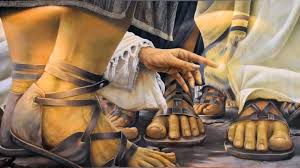
Encounter
I do love the narrative of John 20, heralding all that goes on with “Now the first day of the week,” followed by meeting, mistaken identity, revelation and sending as the first sent one following the resurrection.
It opens early in the day with a solitary female figure from a region called Magdalene, a fishing area derived from Aramaic (Semitic) Maghdela, a place on the Sea of Galilee, literally meaning “tower” (compare Hebrew migdal “tower,” from gadal “be great or high”). Then, in the late 1600s, it was used in the context of protection, but not originally. I will not get distracted by that, as it is not my aim today.
This Mary woke up early on Sunday morning at the tomb that now fills her experience, and she found it was empty. Turning around in confusion, she saw a gardener with questions. A voice broke into her world with familiarity, her name, perhaps saying in her mind, I know that voice.
Being recognised, more than that, but hearing her name, she recognised him and exclaimed, “Rabboni!” (John 20:1-16).
The first word she uttered at that moment was not “Saviour” or “Lord”, but “Rabboni” (“my teacher”), with the emphasis on “My” — please note.
Perhaps the realisation sparked the thought “MY”, Jesus is still mine, and I am still a disciple.
I have made my choice: you are the teacher in my life, the disciple of my being. Have I made that revelatory discovery that by living in the Image and Likeness of the Father, Son, and Holy Spirit, Jesus is my primary instructor? Building this pattern of God in my life, to be understood by all people and to reflect God’s ways and actions, this is my blueprint.
Blueprints of Creation
I initially worked as a Building Surveyor early in my career, focusing on architecture and construction. Even today, I view buildings differently. I consider their design, aesthetics, shapes, and practical use.
On this theme, I often wonder what Moses was given “to build according to the pattern” for the tabernacle. For many years, my life was surrounded by blueprints of buildings that guided the construction. Do I really think Moses had seen blueprints laid out on God’s table? I don’t think so; considering the tabernacle, its furniture, and its construction, I can only conclude it relates to Genesis and the creation. Each day is reflected in its furniture; for example, the seven days of creation correspond to seven items, with the first day, “Let there be light,” linked to a golden lampstand (menorah).
On the second day, we observe the structure itself, the Firmament, with its screens and veils, which can be seen as representing the firmament that separated the waters — the laver being the sea waters breaking forth.
On the third day, we find the bronze altar in the outer courtyard, used for sacrifices, which might correspond to the separation of the earth and seas. And so on.
I suggest that Moses visited creation when he was given a pattern to follow, seeing God’s aim. That the blueprint was creation itself—Moses visiting the event and a pattern being instilled in him to refrain from building outside of it. Creation is the first temple; the tabernacle was merely a symbol of the building pattern of creation. The Tabernacle, therefore, is not just a physical structure but a symbolic representation of God’s creative work and a place for His people to encounter Him.
At the resurrection, the first name given to Jesus—’My Jesus’—is Rabboni, meaning ‘My teacher’, and My disciples, My Life giver.
The manner and words of Jesus should become our common sense, recognising that the living Word is meant to fill our minds, flow from our lips, and find a home in our hearts. Engage with and experience that the Word is alive, as God breathed the “breath of life” into us, just as he did with humanity at the beginning.
Do not approach God’s Word as if it were academic writing, laws, or texts designed solely to restate a dry system of facts for regurgitation or passing an exam.
The Word is to be encountered and to bring transformation.
Living Word
I remember in the science lab when I studied Biology, it was fascinating at 12 years old. We had to dissect animals. I recall cutting open frogs and mice; they were pinned down to a board. The exercise was to understand where the organs were, what they looked like, and everything was visible, but somehow a part of its essence had been lost—that is LIFE.
Similarly, when we consider the Word, remember that it is the living Word of God. We are called to pursue and experience it, not just a frog or mouse to be emptied.
What am I like today? What is the religious life we live? What is our life of faith? I pray we do not remove the life and the beauty from God’s Word. Asking people to eat what is dry and dead. That we don’t just cultivate arguments and theologies for position, but we hand life with life, we have a life to live and a more abundant life.
Here is a clash of the living Word, a question of Jesus from the Law came, “What must I do to inherit eternal life?” (Luke 10:25-37). What a question — inheritance is about receiving, not what must I do to get it, I thought.
The Shema was quoted as saying, “Love the Lord your God with all your heart and with all your soul and with all your strength.” (Deuteronomy 6:4-5). Then the legalised officials pressed again, “And who is my neighbour?”
Jesus, through a story, illustrates the Word as a living entity, the living Word “judges the thoughts and attitudes of the heart” (Hebrews 4:12).
What a Rabboni.
Jesus’ way of discipling and teaching was unique; he carefully wrapped truth in parables. Telling stories and narratives that reached the listener as he taught. To understand, you needed to grasp what was said to get all the essence out of the words.
The Jesus way, Jesus revealed the heart of those who listened. They were simply stories or powerful, insightful instructions.
Jesus is stunning, and his ways are evolving. I love the titles of the late Eugene Peterson’s books on Jesus’ ways, such as ‘Eat this Book’, a way of taking in the living word that constantly challenges life.
Often Jesus taught from a seated, reclined repose, yet it makes you and still makes us stand up straight. (Matthew 5:1-2; Luke 4:20).
This same Jesus is available to you and me today. Rabboin, MY teacher, is available to us right now.
The risen Jesus—our Rabboni, our Teacher—is still alive and available to each of us. The same voice that called Mary by name calls us today, inviting us not merely to study His words but to live them. The living Word continues to breathe life into all who listen and follow.
 Face2Face - Gareth Duffty Blog